10 Tips to Help You Prepare for Your Dog to Meet Your New Baby

My first baby was a 6½ pound, adorable, brown-eyed, soft ….. puppy!!! Our German Shorthair Pointer, Dakota, was our baby for several years before bringing home our firstborn from the hospital. She was protective, well-trained, and accustomed to frequent walks and our undivided attention. I was nervous about our dog adapting to a noisy, sometimes smelly, helpless newborn. Here are a few tips that can help you prepare for your dog to meet your baby. 

  1. Plan ahead. Take your dog in for a check-up if it has been a while. You won’t have extra hands or time once your newborn arrives. Make sure your dog is fully vaccinated.

Dr. Laraway and Willow

  1. Establish who is the real alpha male in your home. Reinforce consistent ground rules – like places off-limits or unacceptable behaviors like jumping. Consider an obedience training course with your pet before your baby arrives.

  1. Prepare for your newborn. As you set up your crib or nursery, do so in stages so your dog can adjust to the new environment. Pets rely on consistency, so make gradual additions, then play with your pet in those areas to help create positive feedback for your dog. Baby gates or closing doors are also effective in training your pet in what areas are off-limits. If your dog puts its paws on the crib or tries to jump in, this behavior needs to be stopped immediately. Keep the door to your baby’s room shut consistently if this is necessary. As you introduce smaller baby items to your dog, supervise it as it sniffs them on the floor. Do not let your dog put them in his mouth.

  1. Dogs have an incredible sense of smell. Some people even believe dogs can “smell” cancer. Help your dog become accustomed to baby smells by providing a treat while your dog explores new baby smells – like baby lotion, powder, or detergent. Introduce your newborn to your dog by allowing your dog to smell your baby first. Let your dog smell the blanket your baby has been wrapped up in before they meet.

  1. Dogs are typically very loyal and protective friends. Allow your dog to meet your newborn on neutral territory like the sidewalk, for example. When you enter your home with your newborn, it is essential to be calm and relaxed. Leash your dog and have a helper hold the leash and provide positive reinforcement with treats.
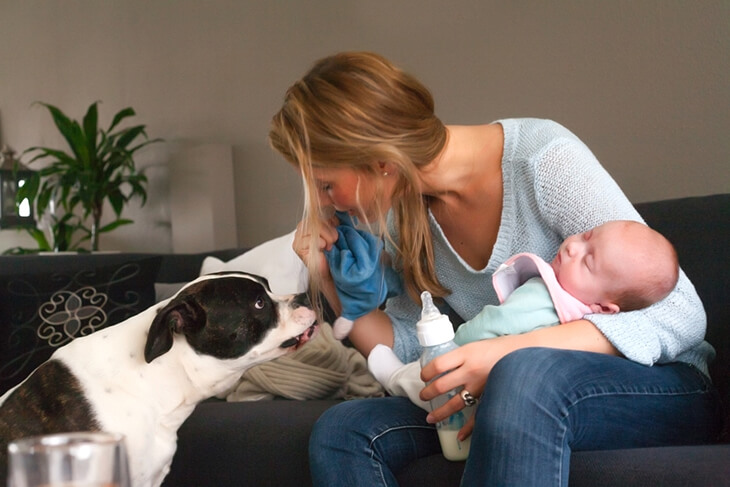
  1. Try to keep regular dog routines – such as walking or feeding – intact where possible. Set aside some particular time to spend each day with your dog. Choose an activity that your 4-legged companion enjoys while someone else watches your baby. Some research suggests that dogs feel jealousy, so being mindful of this can help ease the addition of a new baby to your home.

  1. We all know that dogs have exceptional hearing. They can detect higher frequencies and hear sounds four times further away than humans can. New baby noises and shrill cries could put your dog on edge at first. You can prepare your sensitive pet by softly playing videos of baby sounds (on YouTube) and gradually increasing the volume to help your dog accommodate new noises. Some dogs are calmed by classical music. Consider some gentle background noise as your household transitions to newborn sounds.

  1. Dogs are awesome stress-relievers. They can read emotions. After you tend to your newborn, spend a few minutes with your dog when you need a break from nurturing.  

  1. Always supervise your baby with your dog, no matter how gentle your animal seems. Supervision is even more critical as your child grows since infants may frequently hit, grab, or chase animals. You can practice familiarizing your dog with your baby by carrying around a doll for a few months before you deliver your baby.

  1. Never force your dog to interact with your baby, and remember some dogs become defensive if they feel threatened while eating or playing with their doggie toys. If your dog exhibits aggressive behavior toward your child, you should seek help from an animal behavior expert.   

References

https://www.cesarsway.com/introduce-your-dog-to-your-baby/

https://www.vetwest.com.au/pet-library/children-and-pets-family-safety-bringing-home-a-baby

https://www.animalhumanesociety.org/behavior/preparing-your-pet-new-baby

https://www.aspca.org/pet-care/dog-care/dogs-and-babies

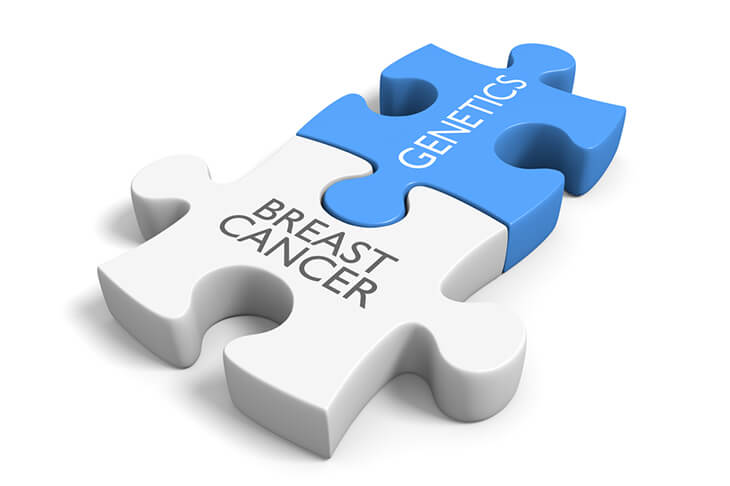
Breast Cancer Risk and Epigenetic BRCA Markers

Chances are you know someone who has been affected by breast cancer. For one out of every eight women, the risk of being diagnosed with it is relatively high. Hereditary breast cancers are only responsible for 5 to 10 percent of breast cancer cases. However, there is a significantly higher risk for women who have the BRCA1 BRCA2 genetic markers. 

Epigenetics is the study of how the environment and your behaviors can affect gene expression. The DNA sequence is not altered, but epigenetic changes affect how the body reads your DNA and determines health outcomes. 

Consulting with a genetic counselor or doing a genetic screening test is beneficial for at-risk individuals. These women have a family history that includes one of the conditions below.  

One (or more) first– or second-degree relative(s) with:

  • Breast cancer diagnosed at age 45 or younger in women
  • Triple-negative breast cancer diagnosed at age 60 or younger in women
  • Primary cancer of both breasts
  • Both breast and ovarian cancer in the same relative
  • Male breast cancer
  • Ovarian cancer
  • Two or more first– or second-degree relatives from the same side of the family with breast cancer, if at least one breast cancer was diagnosed before age 50.
  • Three or more first– or second-degree relatives from the same side of the family with breast or high-grade prostate cancer at any age.
  • Ashkenazi Jew Ancestry

BRCA1 and BRCA2 are examples of epigenetic changes that have significant consequences. BRCA genes are tumor suppressor genes that help combat breast cancer by making proteins to repair damaged DNA. These tumor-suppressing genes do not work correctly for women who have the BRCA1 or BRCA2 genetic marker. These women should be counseled appropriately regarding increased breast surveillance (clinical examinations and imaging/mammograms), starting a family, and possibly undergoing prophylactic surgery to decrease the risk of breast cancer.

Talk to your provider about your family history and potential genetic risk. Do not be fearful, be hopeful. Breast cancer is very treatable, mainly when it is discovered early and treated appropriately. On average, mammograms detect cancer two to three years before a lump is felt. Mammograms are usually covered 100 percent by insurance companies, and there is no copay on your part. If you do not have the means to have a screening mammogram done, contact the Utah County Health Department, as they may help cover the cost of this service. Please complete routine screening examinations and mammograms as recommended for your age and level of risk.

References

American Cancer Society (ACS). (2019). Breast cancer survival rateshttps://www.cancer.org/cancer/breast-cancer/understanding-a-breast-cancer-diagnosis/breast-cancer-survival-rates.html 

American Cancer Society (ACS). (2019). Breast cancer risk factors you cannot changehttps://www.cancer.org/cancer/breast-cancer/risk-and-prevention/breast-cancer-risk-factors-you-cannot-change.html 

Centers for Disease Control and Prevention (CDC). (2020). What is epigenetics? https://www.cdc.gov/genomics/disease/epigenetics.htm 

Dullens, B., de Putter, R., Lambertini, M., Toss, A., Han, S., Van Nieuwenhuysen, E., Van Gorp, T., Vanderstichele, A., Van Ongeval, C., Keupers, M., Prevos, R., Celis, V., Dekervel, J., Everaerts, W., Wildiers, H., Nevelsteen, I., Neven, P., Timmerman, D., Smeets, A., Denayer, E., … Punie, K. (2020). Cancer Surveillance in Healthy Carriers of Germline Pathogenic Variants in BRCA1/2: A Review of Secondary Prevention Guidelines. Journal of oncology2020, 9873954. https://doi.org/10.1155/2020/9873954 

National Breast Cancer Foundation (NBCF). (2021). BRCA: The breast cancer gene. https://www.nationalbreastcancer.org/what-is-brca 

U.S. Preventive Services Task Force (USPSTF). (2019, August 20). BRCA-related cancer: Risk assessment, genetic counseling, and genetic testing. https://www.uspreventiveservicestaskforce.org/uspstf/recommendation/brca-related-cancer-risk-assessment-genetic-counseling-and-genetic-testing 

Canyon-View_Provider_Taylor-Sorenson
providers
Taylor Sorenson, DO
801-798-7301
Family Medicine
providers
Courtney Rogers, LCMHC, NCC
providers
Joey Payne, AMFT
services
Behavioral Health
Load more results