
Whether you plan to spend the week on a houseboat at Lake Powell, the day at Bear Lake or an afternoon hiking Mt. Timpanogos, protecting your skin is important. As you look at the plethora of sunscreen formulations available at the store and online, it’s understandable that many of us are confused as to what is the best kind. A basic understanding of sunscreen labeling and how the sun affects our skin will help you choose the right protection for your family and your outdoor adventure.
The American Academy of Dermatology recommends selecting a sunscreen with an SPF of at least 30, with broad-spectrum coverage, that is water-resistant.
Let’s look at what this really means.
SPF stands for sun protective factor. It basically means that if your skin would start to burn after being outside for 30 minutes, a sunscreen with SPF of 30 would allow you to stay outside 30 times longer (900 minutes or 15 hours) before burning. SPF indicates how well a sunscreen shields unprotected skin specifically from UVB rays. UVB rays are primarily responsible for burns and promote skin cancer.
- SPF 15 blocks 93% of UVB rays
- SPF 30 blocks 97% of UVB rays
- SPF 50 blocks 98% of UVB rays
- SPF 100 blocks 99% of UVB rays
(notice that you don’t get twice the protection from SFP 100 versus 50)
Even though an SPF rating above 50 sounds impressive, it isn’t very meaningful.
The American Cancer Society recommends reapplication of sunscreen every two hours because most people don’t use enough sunscreen to start with, water or sweat makes the sunscreen come off and sunscreen isn’t truly “waterproof”.
As mentioned previously, SPF is a numerical rating of how well a sunscreen protects the skin from burning. So if you used a sunscreen with an SPF of 30, theoretically, you could play outside all day without getting a sunburn. However, most of us know that is not true. If you put sunscreen on your fair-skinned blonde toddler in the morning and never reapplied throughout the day, your child will be burnt to a crisp after spending a day at Seven Peaks! You could even use SPF of 100 and your toddler would still be burned. Sunscreens simply can’t block out all the damaging rays. They are not applied in a thick enough layer and are wiped off, washed off and sweated off.
Broad Spectrum protection means the sunscreen will protect against UVA rays. UVA rays have deeper penetration of the skin which leads to premature aging, including wrinkles and age spots. The SFP label specifically refers to UVB protection, however, according to the FDA, a BROAD SPECTRUM sunscreen will protect against UVA rays at about the same degree. For example, a sunscreen with SPF of 30 will not only block 97% of UVB rays, but it will also prevent 97% of UVA rays from penetrating the skin.
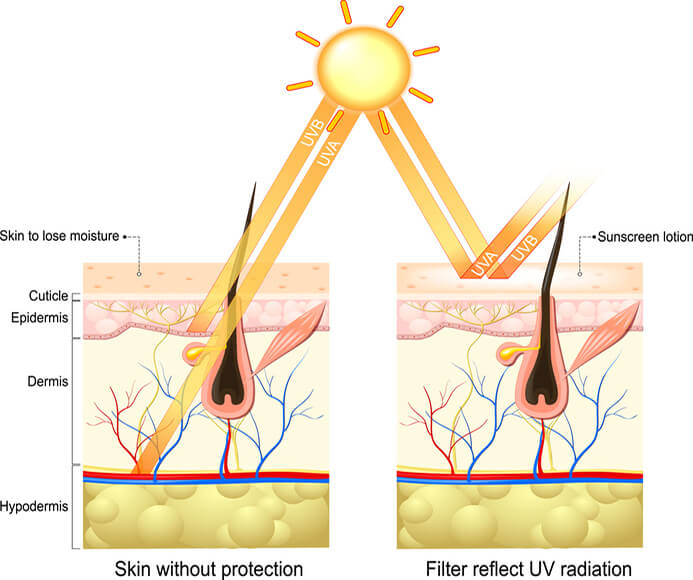
Water-resistant means the sunscreen is formulated to perform well even if you’re swimming or sweating. The FDA requires a specific test for sunscreen to be given this label and will rate the “resistance” level of sunscreen for a specific time frame, either 40 or 80 minutes. There is no such thing as “waterproof” sunscreen and labeling laws have now banned the use of this term.
Recognize that when you towel off, you not only wipe off the water, but also the sunscreen that was shielding your skin from ultraviolet rays. So, regardless of the water-resistance rating and time, you think you should have left …after drying off, you need to reapply sunscreen.
A few other important tips to remember:
- Most people don’t use nearly enough sunscreen. For a person wearing shorts and a t-shirt on a warm summer day, an ounce (the size of a shot glass) should be applied. This amount should be reapplied every two hours. Make sure you pack enough for your hike or outing on the boat. Sunscreen should be applied 15 to 30 minutes before exposure.
- Most sunscreens have a “use by” date stamped on the container, but a good rule of thumb is to discard any unused sunscreen after three years. It is best preserved when it is stored in a cool dry place because heat and humidity hasten its demise.
- Many people with dark skin forget to apply sunscreen or erroneously think they don’t need it. Although darker skin tones prevent a person from burning as easily, the skin can still suffer UV damage. It may also be more difficult to detect abnormal moles or discoloration and cancerous cells.
- Many times people think that getting a “base tan” at the beginning of the season or before going on a trip is a good idea. A “tan” occurs when the ultraviolet rays hit the skin, which causes the skin to produce more melanin in an attempt to darken the skin color and maybe shield some of the UV rays. A “base tan” may help minimize burns, but it is still causing skin damage. It is better to protect the skin from UV damage by using sunscreen, sun-protective clothing or shade.
- Certain medications cause sun sensitivity and will promote sunburn more readily. Classic culprits include treatment for acne, some antihistamines or antibiotics, specific anti-inflammatory medications, and some herbal supplements. Read the cautions on your medication labels to avoid sun damage and burns.
- MOMS, remember, the sun’s UVA rays penetrate glass, so you still need to apply sunscreen, even if you’re just chauffeuring kids back and forth to activities all day.
- If you wear foundation, apply sunscreen first and then put on your foundation. Many foundations do not have the broad-spectrum protection that you need. (Meaning they shield against UVB rays but not UVA rays.)
- According to the American Academy of Pediatrics (AAP), babies under 6 months of age should be kept out of the sun or covered with protective clothing. (Sunscreen may be used only on small areas, such as the face if protective clothing and shade aren’t available.) Remember, UV rays are reflected from shiny surfaces (like water) so hanging out at the splash pad may expose you or your child to direct rays from the sun AND the rays reflected off the water.
- Spray sunscreens should not be used on children because they may accidentally inhale some of the chemicals into their lungs. Because of the smooth application provided by sprays, many people don’t get enough sunscreen on their skin to provide adequate protection. Sprays can be handy for applying sunscreen over thinning hair or where the hair parts, but a hat will provide much better protection.
- Remember, children have thinner, more sensitive skin. This may allow them to burn more easily and damage by UV rays at an early age may dramatically increase their risk of serious problems later in life.
So be SUN SMART this summer. Have fun with your family and loved ones while protecting against damaging, discoloring and destructive UV rays.
Sources:
https://www.ncbi.nlm.nih.gov/books/NBK268889/
https://www.ewg.org/sunscreen/
https://www.theguardian.com/us-news/2019/may/22/chemicals-in-cosmetics-us-restricted-eu
https://www.consumerreports.org/sunscreens/what-you-need-to-know-about-sunscreen-ingredients/