Spring is a beautiful time of year that brings renewed life to our environment and often sparks new well-being motivations. Exercise is one of our most potent and beneficial medicines. May is National Physical Fitness and Sports Month, another reminder of how movement gives us life and rejuvenation.
Exercise has many benefits. It strengthens our bones and muscles. It reduces our risk of certain cancers, helps us maintain healthy body weight, reduces our risk of heart disease, and increases our chances of living longer with a better quality of life. Exercise helps our bodies release substances such as endorphins and endocannabinoids that improve our mood and overall mental health, help us sleep well, improve our sexual health, and decrease widespread pain in our bodies. Exercise helps our brains stay sharp and enhances our learning and judgment skills. Exercising with others can be fun and have many social benefits as well.
Motivation to exercise comes like the waves of the ocean. Sometimes we catch a surf wave and ride it for quite some time before getting knocked down, and other times, we might get excited as the perfect wave approaches, only to faceplant several seconds later. Do not worry; it is uncommon to be an ideal exerciser.
The important thing is to reorient ourselves and keep riding those waves of motivation. Focus on your successes and not your faults. Shame is a tactic used by many well-meaning people and organizations to try and implement change. Still, we learn that shame cannot create long-term healthy change without psychological damage. Please don’t allow yourself or others to shame you regarding how your life is lived. Celebrate your successes and find ways to enjoy the fantastic benefits of exercise.
Whenever I am asked to help someone start a running program or train for their first race, I like to share one of my favorite anecdotal tales:
“Every morning in Africa a gazelle wakes up and knows that it must run faster than the fastest lion or it will be killed. Every morning a lion wakes up and knows that it must run faster than the slowest gazelle or it will starve to death. It doesn’t matter whether you are the lion or the gazelle when the sun comes up, you better start running.”
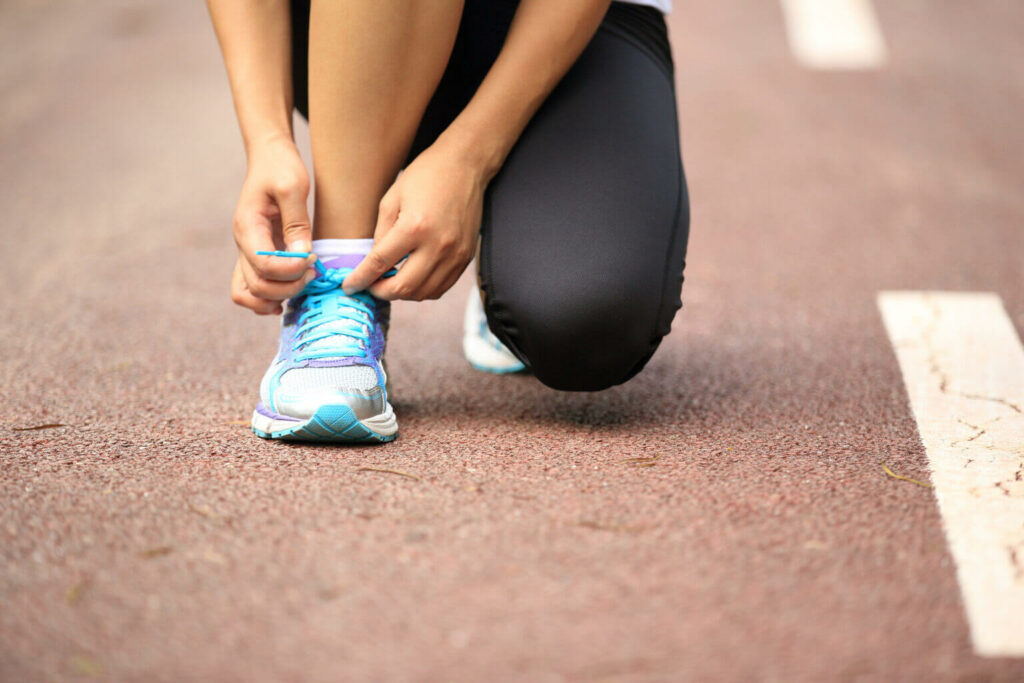
Let’s be honest…running isn’t always fun. I am a runner, and truth told, I can remember a time or two when it was downright miserable. However, there is something about waking early when most of the world is asleep, lacing up my shoes in time to feel the cool morning air, and hearing the sounds of nature coming to life around me. My love for running wasn’t immediate and I certainly wasn’t good at running the day I started. For most people, it takes time and effort to reap the benefits running can provide. I have spent many years figuring out what keeps me motivated while trying to find a balance in how hard I can push my body without injury. What works for me, may not work for you. Maybe running is not your thing. No worries, you are not alone.
Whether it be running, walking, swimming, cycling, or any other moderate-intensity workout, according to the CDC, nearly 80% of Americans do not meet the goal of 150 minutes of aerobic exercise per week.
A recent poll asked Americans why they did not exercise. Surprisingly, “I don’t like to exercise” came in behind “I don’t have time” and “I’m too tired.” Albeit, “I’d rather watch Netflix,” was not too far down the list.
It’s not that we all haven’t heard we need to exercise to be healthy, but it appears exercise is not on the top of most of our to-do lists. If you find yourself somewhere in the “I hate exercise and I’d rather watch Netflix category,” here are a few things that might help:
What’s your thing?
Running happens to be my thing, but running might not be your thing. What is your thing? Finding an exercise that you enjoy is key.
Did you like to Roger Rabbit, do the Twist, or dance the Samba back in the day? Try Zumba.
Were you on the swim team in high school, need a low impact sport, or just like doing your hair twice daily? Maybe aqua aerobics, or better yet aqua Zumba may be your jam.
Perhaps having an outfit (you call a kit) that looks like you are a member of a racing team, sounds like fun–try cycling.
Are you motivated by competition? Try signing up for a 5K or a mini-triathlon.
Schedule it.
Make exercise a priority. Make it part of your everyday routine. It can take a while for a new behavior to become a habit, so give yourself time to get into a regular routine. One way is to try to be active around the same time each day. Another way is to schedule a weekly class or schedule a repeating exercise date with your friends. You are much less likely to cancel on a friend than to cancel on yourself. Once it becomes a habit, you will miss it when you are unable to exercise. Jim Ryun, the first high school athlete to run a sub-4:00 mile, said, “Motivation is what gets you started. Habit is what keeps you going.”
Never give up. Keep trying.
If you tried running, and you really did hate it, then try something else. If you have had an injury in the past, and are afraid of being hurt again, try swimming, walking, or the elliptical. Just because you haven’t liked or done well with keeping an exercise routine in the past, does not mean it will not stick this time.
Thomas Edison said, “Our greatest weakness lies in giving up. The most certain way to succeed is always to try just one more time.”
If you miss a day or a workout, don’t worry; hit it again the next day. If what you are doing isn’t working for you, try a different workout, try a different time of day, or try finding new friends.
If 150 minutes of exercise a week sounds overwhelming in the beginning, break it up. Try 30 minutes, five days a week, or 50 minutes three days a week. It also works to do ten minutes here and ten minutes there, just make it count, it all adds up.
The benefits of exercise include stress reduction, better sleep, improved mood, and sharpened focus. These benefits are almost immediate and can be felt right away. The longer-term benefits of reducing your risk for type II diabetes and some types of cancer, controlling your blood pressure, and maintaining a healthy weight will over time, help you to live a longer, healthier life.
The key to establishing and reaping the rewards of exercise is finding that thing you enjoy (or at least don’t hate), doing it with people you like, making it a habit, never giving up, and remembering, someone, somewhere, once said, “No matter how slow you go, you’re still lapping everyone on the couch.”
Feeling cooped up and tired during the quarantine? The answer to the problem is Green Exercise! Get outside and feel the “magic”. Watch and learn more about the miracle of Green Exercise.
January brings seemingly inevitable regrets about holiday excess and a renewed set of good intentions. And our yearly attempt to change our lives through “New Year’s Resolutions”. As I type this, on January 12th, many of us have already tried and failed to make meaningful changes to our lives. Studies show that most New Year’s Resolutions are broken by mid-January and almost all are broken by Valentine’s day. Just in time for a box of chocolates.
How do we do better? How do we actually make changes that stick?
There is a lot of research about habit formation. Much of it is based on what some call the “Habit Cycle.” Most describe this as a cue or trigger, an action, and a reward. The more obvious the cue and the stronger the reward, the more often the action. If we understand how powerful that cycle is in our lives, we can learn what triggers us to often unconscious action, and what rewards prompt those actions to occur over and over.
Many researchers have asked us to first spend some time and get curious about the habits we have. If there is something we are doing repeatedly, we should ask ourselves, “What triggers that action?” We should ask ourselves “what reward am I getting for that behavior?”
I recently asked these questions about one of my bad habits, mindless snacking.
At work I often retreat into my office to get a break. But it isn’t really a break, because my computer is staring at me and I can literally see the phone messages and to-do items blinking at me. It sounds strange, but when I sit in my office I often immediately stand up and wander the office to get a temporary break from work. And because it is strange to wander purposelessly in the office, I have found that wandering in search of a “treat” makes sense to my employees and colleagues. When I pass someone in the hall I don’t have to say “I am just walking around the building to get away from my phone messages”, I can say “I am just grabbing a snack from the break room.” I am now triggered by sitting and looking at my laptop. My action is to stand and look for food. The reward is a break from work on a long 10 hour day.
Over the years, this trigger-action-reward cycle has generalized to other situations. Now, when I am at home, I find that when I sit down at the computer to check e-mail or pay bills, I often last just a few minutes before I am wandering the house in search of a snack. In fact, as I was preparing a presentation on this topic just a couple weeks ago, as I sat down to go over my notes one last time before my presentation at the Clyde Recreation Center in Springville, I found myself in the pantry with a bag of chips in my hands. This was as I was preparing a talk on how to break bad habits and establish new ones!
Other than getting curious about the trigger-action-reward cycle, what advice do experts give us on how to establish long-lasting habits?
Ten Rules for Creating Habits:
Work on one new habit at a time. Trying to change multiple habits is overwhelming.
Take advantage of life changes. The best time to stop smoking is on vacation. The best time to start exercising is after moving to a new house or apartment.
Commit for the long haul. Bad studies done in the 1950’s suggested that new habits can be cemented after 21 days. Newer studies show that implementation of new habits can take many months. Don’t be discouraged if you slip here and there; the trick is to keep moving forward.
Small habits can be powerful. I tell my patients, even the morbidly obese patients, that I don’t want them to lose 30 pounds. I want them to lose 3. And then lose another 3. And then lose another 3. We shouldn’t start with a goal of walking an hour a day; we should start with a goal of walking 10 minutes after work. A goal of getting up an hour earlier to exercise might fail. But getting up 5 or 10 minutes earlier will succeed.
Anchor new habits to established habits. I ask patients to duct tape their medication bottles to their toothbrushes so they remember to take their pills. It works. A researcher at Stanford wanted to do 20-30 pushups a day. So he began doing 3 pushups every time he went to the bathroom. Over a day, he met his goal, 3 pushups at a time.
Plan for obstacles. What will you do if it snows? What will you do if your Mother-in-law comes to visit? What will you do on vacation?
Create accountability. Use social media. Find exercise buddies. If someone is knocking on your door at 6:15 every day, you are much more likely to go walking.
Create obvious cues. Leave your earbuds on a hook by the door. Put your exercise clothes on a hook in your room. Hang the dog leash on the door knob.
Create meaningful, small rewards. Planning to only go on a vacation if you lose 30 pounds will not motivate you. Getting to watch the next episode of a great Netflix series will. I often suggest that new moms go walking for exercise. And for a break. I ask them to leave their phones home, so they are truly “off the clock.” And I privately suggest that they secretly walk… to the library where they can sit in a big chair and read a book without toddlers and newborns interrupting them.
Create a new identity. Become a daily walker. A runner. A biker. A reader. Someone who walks the dog. Someone who doesn’t quit.
Establishing new habits and breaking old ones takes work. So where should we start? What gives us the most bang for our buck?
I presented recently on Blue Zones. National Geographic has published beautiful photo essays on these communities. People in these areas live on average 8-12 years longer than the rest of us. One Blue Zone is on the island of Okinawa, another is on the Island of Sardinia, and another is located in Loma Linda, California. This research team tried to answer questions about what these people do that enables them to live longer, happier, and better lives.
They boiled their research down to four suggestions: move, nourish, refresh, and connect.
People who live long, happy lives move all the time. They walk. They work. They do. They eat more plants than meat. (Dr. Paxton talked about evidence-based diets at a presentation at the Clyde Recreation Center you can visit https://canyonviewmedical.com/community-health-seminars/2019-seminars/in the coming weeks to watch his presentation). They have a purpose in life, a reason for living, something that motivates them to get up every day. And they are part of what one researcher called the “right tribe.” Their friends also move daily, eat healthily, have a purpose to life, and value lasting friendship.
That research is fascinating and is worth reading about and eventually implementing fully. But focusing on all of that at once violates my Rule #1 above… to be successful we need to start with just one goal, one habit we want to implement.
So again… what do we start with? What to do first?
There is a great YouTube video that I recommend to my patients that answers this exact question. It was produced by Dr. Mike Evans and is called “23 and 1/2 hours.” You can watch it here –23 and 1/2 hours. His main point, which he supports with a fun review of good evidence based literature, is that 30 minutes of exercise a day does more for your health than any other intervention we know of.
So if you are to start with one goal, it should be to build up to 30 minutes of exercise every day. You can break it up… 15 minutes before work and 15 minutes after, but that simple activity will add years to your life.
It doesn’t sound like much, but most of us are not doing it. We need to start small, with a goal of a few minutes of exercise each day. We need to think about triggers and rewards. We need to get curious about what motivates to exercise and rewards us for doing it. We need to follow the 10 rules above so we can cement that habit as part of who we are.
We need to establish our identity as a community who together, somehow, someway, finds time to exercise 30 minutes every day.
Let’s work together on creating a new “Blue Zone” right here in Utah County, so that someday National Geographic will send a team to take beautiful pictures of us and ask us what we are doing differently that allows us to live longer and better lives.
You may not be aware that May is National Physical Fitness & Sports Month. With that in mind,
I’d like to provide you with some information that can assist you in becoming more active. Most of us know that regular consistent exercise is a key aspect of our overall health and wellness.
Unfortunately, many of us also fall short of a consistent exercise routine and lack direction. As a family and primary care sports medicine physician, I try to have a discussion with patients who come in for yearly preventive visits regarding their activity level. Most patients who are not in the habit of exercising regularly refer to time constraints as the reason for inactivity. When this is the case, I like to counsel my patients regarding some of the proven benefits of regular exercise and also introduce them to a simple exercise program that can be completed in only 7 minutes.
There are numerous known benefits to regular exercise including improved blood pressure, lower blood sugar, lower cholesterol, weight loss and maintaining a healthy weight, improved emotional well being enhanced cognitive function and better-perceived quality of life. The effects of regular exercise can result in less anxiety, depression, heart disease, diabetes and cancer.
Introducing The Scientific 7 Minute Workout:
I was first introduced to the Scientific 7 Minute Workout during my sports medicine fellowship training. It is a simple, but effective daily exercise routine that can be completed in 7 minutes per day. It consists of 12 simple exercises (as seen above) that are performed for 30 seconds each. There is no fancy or expensive exercise equipment required or a gym membership to be paid. Doing the exercises will help you break a sweat and increase your heart rate each day, helping you get closer to better health and wellness with each workout.
Everyone has 7 minutes to spare. I challenge you to try out the Scientific 7 Minute Workout today and start enjoying the benefits of regular consistent exercise…and while you’re at it, invite your spouse or a friend to join you along the way!
You walk into the house after a long day at work. Johnny is sitting in the family room playing video games and Jennie is lying on her bed texting friends and watching TV. You know your family needs to be more active. You know too much screen time is harmful to theirhealth. You know that you must set a good example for a healthy lifestyle. But how can you do that when all you want to do is sit down and join them? Well, it’s time to tackle the impossible and get everyone up off the couch.
The US Department of Health and Human Services recommends 60 minutes or more of physical activity every day for children 6 to 17 years old. They recommend a minimum of 30 minutes, 5 days a week for adults. An active lifestyle has many benefits for the entire family. It improves cardiovascular fitness, builds strong bones and muscles, and helps to control weight. It helps with mental and emotional well-being and reduces symptoms of anxiety and depression. Physically active kids have better grades and better classroom behavior. Structured group activities help build self-confidence and provide social interaction.
It is important to make the activity a fundamental part of your life. Here are a few ways you can help your family move more each day and have some fun while you are doing it:
Get everyone involved
Hold a family brainstorming session and come up with a list of fun physical activities.
Spend family time being active
Play at the park.
Take a walk after dinner.
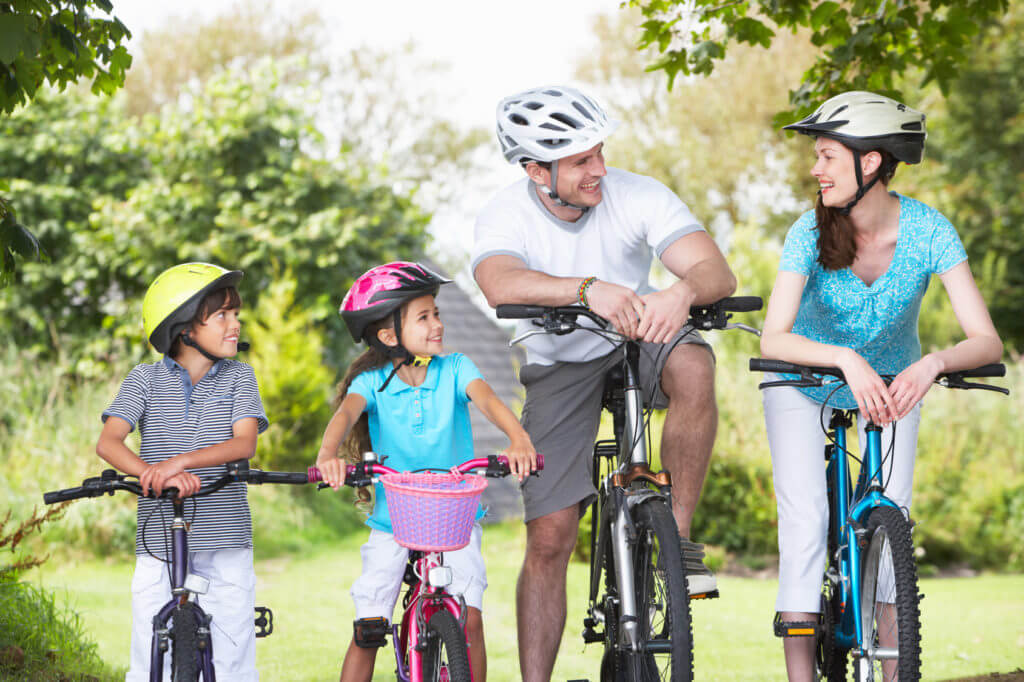
Go for a family bike ride (wear helmets).
Play a sport together (basketball, soccer, softball).
Take an active vacation (hiking, skiing).
Add physical activity to your daily routine
Walk or bicycle to school instead of riding in a car.
Take the dog for a walk.
Take the stairs instead of the elevator.
Park farther away from the store.
Learn a variety of skills to find what you love
Teach your kids how to ride a bike or ice skate.
Enroll in a class to learn to swim, dance, or ski.
Look into organized sports or clubs that suit your child’s interests.
Limit Screen Time
Limit screen time to one or two hours a day.
Don’t put screens in bedrooms (TV, phones, computer, video games, etc.) Kids will spend more time away from the rest of the family if there is a screen in their room.
Turn the TV off during meals. Family meals are a good time to talk to each other.
Active parents tend to have active children. It is up to you to be a good role model, encourage family and individual physical activity, and enforce the rules.
My parents grew up in the great depression and taught me to be very careful with my money. We grew up eating pretty much Western Family brand everything and planning our summer vacations based on the price of gasoline.
I wait to buy things until they go on sale. I am always looking for ways to get the most “bang for my buck”.
As a physician, a lot of what I do at work is writing prescriptions for VERY expensive medications. Over the last 20 years, I have written for lots of medications that reduce the risk of heart attacks and strokes in my patients.
There are now a number of cheap, generic medications available that literally save lives. Lots of lives.
The coolest thing is that research has now conclusively proven that the best medication to reduce heart attacks and strokes is 100% free.
That makes the cheapskate inside me smile.
The absolute, best medication to reduce your risk of heart attack and stroke is 30 minutes of daily exercise.
30 minutes of mild to moderate exercise each day decreases your risk of cardiovascular events by 30 to 40 percent!
That is as good or better than medications that cost hundreds of dollars per month.
And the only side effects are decreased anxiety and depression, loss of weight, reduced risk of type 2 diabetes, reduced cancer risk, stronger bones, improved function, prevention of falls, and longer life.
This has led to a recommendation by the Surgeon General that “every American adult should participate in 30 minutes or more of moderate-intensity activity on most, and preferably all, days of the week.”
Moderate activities are things like walking briskly at 3 miles per hour, or yard work, household tasks, cycling, or swimming. These activities would burn about 600 to 1200 calories per week.
And the activity can be “accumulative”… in other words you can do 10 minutes in the morning, 10 at lunch, and 10 when you get home.
So the best, cheapest, most “bang for the buck” prescription I can write is for exercise!
The weather is finally beautiful. Our excuses are gone….
Go for a walk, ride your bike, mow the lawn, hike the “Y”, play with your kids. You will live longer, better lives on the Western Family brand!
With more than four million babies born in the United States each year, it’s easy to forget how miraculous each newborn really is. Once an egg is fertilized it must undergo millions of cell division and differentiation in order to develop into a normal baby.
Since you have little or no control over the genetic programming and replication of a fertilized egg, it makes sense to focus on the things that you do have control over, to balance the scales in your favor. You can control how you take care of your body and how you respond to environmental factors or chronic illness.
When you prevent the scale from tipping toward the heavy end, it will be easier to become pregnant and carry a child successfully. Weight control also has a profound impact on avoiding certain chronic health conditions that are a direct result of being overweight.
Whether you are trying to get pregnant or are already pregnant, you can increase your chance of delivering a healthy newborn by managing your weight appropriately. Here are three simple steps to help you on this journey.
know your BMI
set a target gain
monitor your weight
know your BMI: Before knowing how much weight you should expect to gain during pregnancy, you must first know where you stand prior to conception. This is typically measured by calculating your body mass index (BMI). BMI measures how appropriate your weight is for your specific height. BMI is not perfect as it doesn’t take into account age, sex or body type but does give a general idea of how appropriate your weight is. BMI is easy to calculate and accurate for most people.
Use the following online calculator to calculate your BMI
set a target gain: It is helpful to know how much weight you should expect to gain during pregnancy. A shorter or smaller woman should aim to gain amounts at the lower end of the range. The current recommendations set by the IOM in 2009 are:
normal BMI –
25 to 35 pounds
underweight –
28 to 40 pounds
overweight –
15 to 25 pounds
obese –
11 to 20 pounds
twins gestation –
up to 45 pounds
monitor your weight: Routine prenatal visits are an ideal way to routinely record weight gain. However, these visits are often monthly initially, and weight can quickly skyrocket out of control if you don’t take responsibility for your own weight. Use the scale as a measuring tool NOT a judgment scale of how good you are. Take accountability for your weight and please discuss any problems or concerns that you may be having with your provider.
Here are some of the benefits for you in maintaining the proper weight:
☺ PRE-PREGNANCY: It will be easier to become pregnant, especially if you have Polycystic Ovarian Syndrome (PCOS). A modest weight loss of just five to ten percent can often normalize your cycles and make it easier to become pregnant.
☺ Achieving your target gain will ease the discomforts of pregnancy: heartburn, backache and various pains (i.e. sciatica).
☺ It will make labor easier and decrease the chance for prolonged labor or the need for a c-section. When you are physically fit, the uterine muscles tend to contract more efficiently and physical exercise creates mental power as well as physical strength.
☺ Your recovery period will be shorter. This will give you more energy to take care of what matters most…your new baby!
☺ You will return to your pre-pregnant weight more quickly during the postpartum period.
☺ Research has shown that women who gain too much weight during pregnancy were two to four times more likely to become overweight or obese in the future.
☺ Gaining the appropriate amount of weight will help emotionally. Along with the physical burden of weight comes to fatigue, discouragement, self-esteem issues, and possibly depression. You will feel more like yourself.
benefits for baby:
☺ Appropriate weight gain lessens the chance of delivering a baby that is too big or too small.
☺ A normal weight gain decreases the chance that the baby will need services of the neonatal intensive care unit (NICU) because of newborn trauma or distress, thus minimizing the risk of maternal/newborn separation.
☺ The March of Dimes suggests there may be a link between rising obesity rates and increasing birth defects.
☺ Research has shown that very small and very large babies have a greater chance of becoming obese later in life. Large babies have more fat cells which can increase in size as children grow and eat excess calories. Small babies are deprived in utero and have learned to adapt to less food by holding onto calories. They typically catch up after they are born and acquire more central fat. This is the visceral fat that contributes to heart disease in adulthood. Small babies are conditioned in-utero to become very efficient at storing energy as fat for future needs.
☺ The bottom line is: gaining the appropriate amount of weight during pregnancy improves the likelihood that your child will have good health in the future.
noteworthy:
☼ The average woman should gain 10 pounds by mid-pregnancy to decrease the risk of having a baby that is small for gestational age (SGA) or smaller than expected.
☼ A sudden sharp increase in weight of three to five pounds during a week in the last trimester may indicate excessive fluid retention and be a sign of preeclampsia.
☼ Weight gain will vary with each pregnancy and among women, but if there is anything out of the ordinary, you should discuss this with your health care provider.
☼ Since more than half of women in their reproductive years’ ages 18 to 40 are overweight (BMI of 25 or more) or obese (BMI of 30 or more), be sure to discuss the target weight gain with your provider. This should be addressed at your first prenatal visit with your pre-pregnant BMI in mind. Studies have shown a correlation between providers’ recommended weight gain and a woman’s actual weight gain during pregnancy. Hence, if you have a goal in mind and write it down, you have a better chance of achieving your target gain, and not more.
Pregnancy is not an excuse to lay around and procrastinate beginning a regular exercise program. It is true, there are some pregnant women who should not exercise because of a specific health condition but most expectant women will benefit from being active during their pregnancy.
Regular exercise during pregnancy helps in gaining the appropriate amount of weight, maximizing fetal health and making it easier to lose the extra pounds after delivery. It frequently makes labor and delivery faster and more efficient, enabling a quicker recovery postpartum and decreases the risk of developing preeclampsia (a condition during pregnancy characterized by high blood pressure, protein in the urine, and swelling), gestational diabetes and other maternal complications. Sometimes women are concerned that exercise may harm their baby. Research has shown that with proper nutrition, exercise does not negatively affect the growth in the fetus. It does, however, prevent excess fat from being laid down by the baby and may play a role in preventing very large babies, who are at increased risk for lifelong weight problems. There has been no evidence to suggest that hyperthermia (or increased body temperature) associated with exercise poses a problem to you or the fetus. However, proper attire to prevent overheating or constriction is recommended. Pregnant women should be proactive in drinking plenty of water and wear appropriate shoes and a supportive bra.
If you have already established the habit of regular exercise before becoming pregnant, you may safely continue many of the activities that you are regularly participating in during the first half of pregnancy. Things like running, tennis, aerobics, kickboxing, Zumba and athletics are good to continue for most women. Be aware, however, that as the uterus grows, your center of balance will change, and activities and sports that require agility and balance may need to be modified or postponed until after delivery. As you (and your baby) grow, it becomes easier to lose your balance and fall and you are more likely to sustain bone or muscle injuries with activity. Frequently, this doesn’t mean you have to stop what you are doing but you may have to move more slowly and purposefully in order to prevent injuries. During the latter part of pregnancy, it is important to avoid activities that could cause a fall on your abdomen or cause any direct impact on your abdomen. These types of trauma may cause injury to the fetus or placenta. Use caution with activities requiring high altitudes, exercise that include jumping or jarring motions, or activities that have a high risk of falling (such as water skiing, downhill skiing, or in-line skating). Scuba diving should be avoided at all times during pregnancy.
WHEN STARTING AN EXERCISE REGIMEN DURING PREGNANCY:
□ Begin with walking or some kind of moderate aerobic conditioning that you enjoy [low impact aerobics, swimming (but avoid breath-holding), rowing, elliptical machine, or cycling on a stationary bike].
□ Select an activity that allows for minimal stress on joints, as pregnancy naturally causes weight gain and therefore increased strain on the joints, tendons, and ligaments. During the latter part of pregnancy, hormonal changes cause laxity in the ligaments (especially in the pelvis) to prepare the body for delivery. These changes also increase the chance of strain or injury.
□ Remember to stretch before AND after exercise to minimize muscle soreness and strain.
□ Be diligent in keeping yourself hydrated throughout your workout sessions and keep your heart rate to less than 140 beats per minute.
□ Avoid activity that requires you to be flat on your back. As the uterus grows, it may impede the blood flow back to the heart by physically applying pressure to the inferior vena cava (the major blood vessel that lies next to your backbone). If there is less blood flow to the heart, there is less blood carrying oxygen and other nutrients to the brain and fetus.
□ Motionless standing causes the blood to pool in the lower extremities, potentially causing a feeling of dizziness or lightheadedness. This will also increase the pressure on varicose veins and swelling in the feet and lower legs.
IDEAL FREQUENCY OF EXERCISE:
Cardiovascular or aerobic exercise should be done at least three days per week for a minimum of 20 to 30 minutes per day. Ideally, you will work up to 45 to 60 minutes on most days of the week. Don’t exhaust yourself. While doing cardio, aim for an intensity such that you could have a conversation but would probably choose not to. Brisk walking is a great form of cardiovascular exercise. A pedometer provides a fun and helpful way to measure your goal. Aim to get at least 10,000 steps per day.
Strength or Resistance Training should be done at least two to three days per week for 30 to 45 minutes.
EXERCISE CAUTIONS:
For all women: Consult your provider before commencing a new exercise program if you have heart, lung, kidney or liver disease, diabetes, chest pain, specific joint or muscle pain, problems with dizziness or balance, are over 40 or for any uncontrolled chronic condition.
For pregnant women: Consult your provider first if you have any of the above chronic conditions or special circumstances with pregnancy that may limit your activity, such as spotting or bleeding, threatened or recurrent miscarriage, weak cervix, premature labor or preterm birth or a low-lying placenta.
When making recommendations to patients about things they can do to improve their health I often share two things.
First, my favorite tool to help people get more active is a YouTube video I found a few years ago. It has nearly 5 million views and has helped a number of my patients get motivated to exercise regularly.
Just 20 minutes of exercise each day can have a big impact on your health. An additional 10 minutes can have an even greater impact.
Second, I recommend the book “Mindless Eating” by Brian Wansink. It presents simple doable strategies to change lifestyle habits that gradually promote weight loss. I like books on weight loss and fitness that are not trying to sell something. I have seen too many patients waste money on fad diets and multi-level marketing scams which trick them into cycles of starvation and over-eating. The best diets are those that are reasonable and sustainable… the best diets are lifestyle changes.
My current favorite lifestyle change is the “Mediterranean Diet”. With the exception of its focus on alcohol, that diet is clearly associated with healthier living. My family visited Italy in 2010 and we all noticed that while there certainly are some obese people there, there are many more overweight and out of shape people back in Utah. Interestingly, Utah is one of the healthier states in the US. Eating better, eating slower, taking a walk after dinner… these are all simple lifestyle changes that can get my family and my patients moving in the right direction.
I like to joke with patients that in Utah we don’t follow the Mediterranean Diet but rather the “Chuck-a-Rama” diet. Many of us with depression-era parents or grandparents subconsciously look for ways to get the most food for our dollar. I catch myself calculating this when we eat out; if I am at a restaurant I am trying to figure out how much food I can get for my 10 bucks. My eyes are drawn to the biggest entrée rather than being drawn to the BEST entree. Focusing on how to get the most calories for the dollar just adds inches to my waistline and removes years from my life. Instead of trying to figure out how to get the cheapest food, we should focus on how to cook, grow, and eat the BEST food.
May is the month to plant those tomatoes, to start planning trips to farmer’s markets. Food is relatively cheap now compared to what it was in previous generations. We can break free from that “Grape of Wrath” depression-era thinking, and change our food culture from a glorification of the all-you-can-eat buffet to a culture based on quality over quantity.
Utah is a state that has a healthy outdoor recreation culture. We need to build on that. Europeans visit Utah not for our amazing all-you-can-eat buffets, but for the hiking, biking, and skiing that we sometimes take for granted. I like to challenge my patients to focus date-night planning and weekend get-away planning not on what restaurant you will visit, but what mountain you will climb, what trail you will hike, what part of Utah you will discover.
If we get out, get moving, and focus on quality food and activities where we move instead of sit I am confident that we can turn around the epidemic of heart disease and diabetes that is overwhelming us.